
I have crossed the same border my whole life, and it has never once been the same crossing.
The first time I remember it, I was a child, and we crossed the Rio Grande in a small rowboat. We would load our belongings into it — everything we needed for two weeks — and someone would row us across the river into Mexico, into the summer that was the highlight of my whole year. On the other side there were no paved roads. My great-uncles would gather us into their old manual Chevy trucks and drive us up through the mountains on narrow winding trails, and sometimes the trucks would lose their grip on the steep grade and slide backward, and we would scream, and it was terrifying, and it was the best thing that had ever happened to us. We were going to San Carlos.
They call it San Carlos for the canyon that runs through it, though on the map it is Manuel Benavides. It was small enough that word traveled before we did — everyone knew the day "the American girls" would arrive. That was me and my cousins. It took them about a day to discover that this American girl was perfectly bilingual, that the Spanish was fluent, that I was not a visitor to be humored but one of their own who happened to live on the other side of a river.
The electricity went off at eight every night. We did not miss it. We filled the dark with our cousins' stories, and when the stories ran out we climbed into the beds of our uncles' trucks and lay on our backs and looked up at a sky with nothing in it but stars. No strip lighting. No highway glow on the horizon. Just the sky, exactly as it had always been.
And in the afternoons it would rain, and cool everything, and leave behind a smell I have spent my entire life trying to breathe again. It is the cleanest air I have ever known — the smell of desert rain on hot ground, and I have never found it anywhere else, and I did not expect to find it again. I want you to hold onto that smell, because it is the whole point of this letter, and it comes back.
I crossed that border again last month. Not by rowboat. On foot, at PedWest in Tijuana, on my way from the Valle to the airport in San Diego — a crossing I had never made before. I was buying a torta from a vendor on a corner, and there, sitting on a windowsill as if someone had left it for me, was a single puzzle piece. If you know me, you know what that means. Puzzle pieces are how my grandfather and I have always found each other. And there it was, on a random sill in Tijuana, waiting.
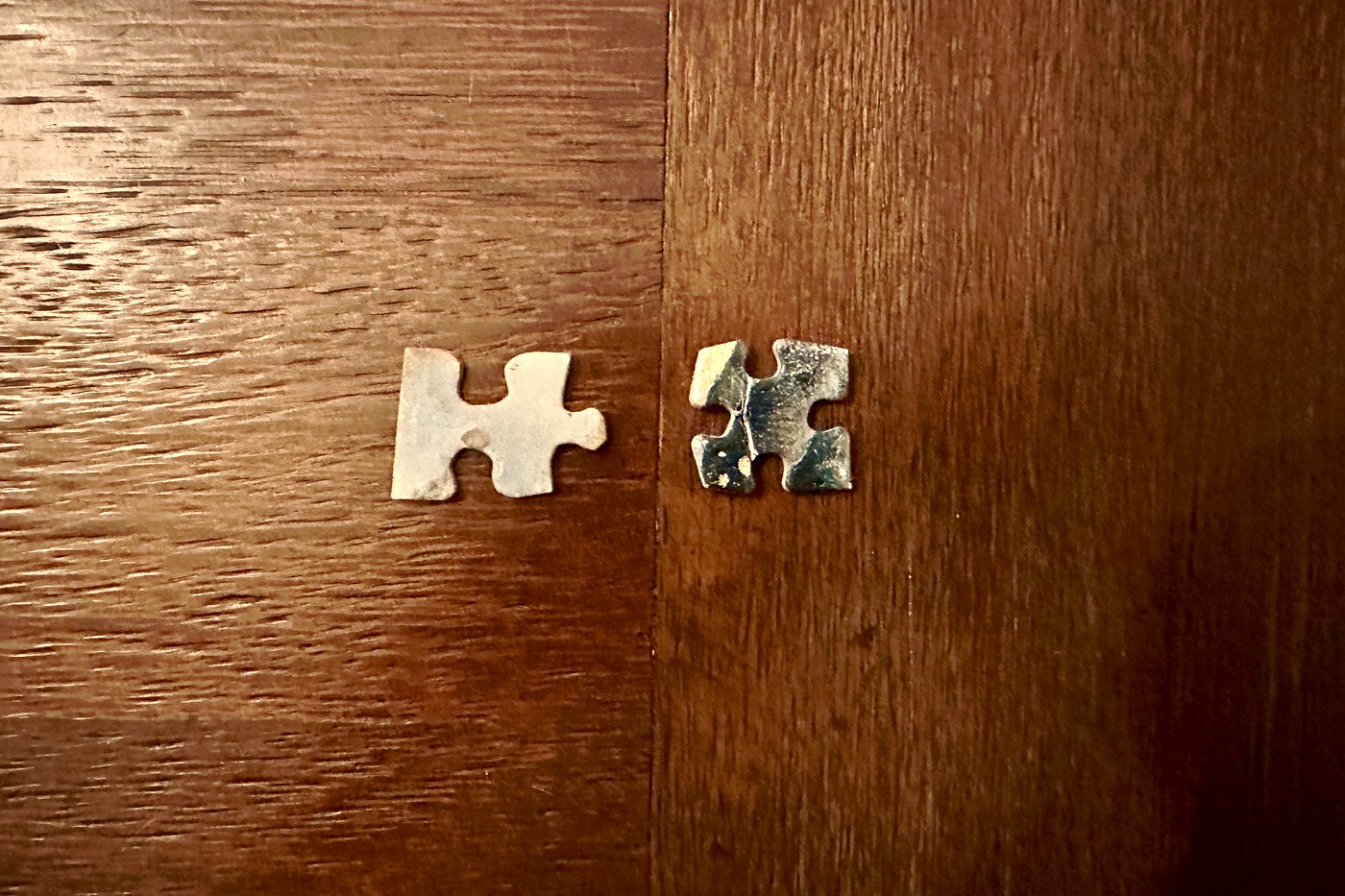
I picked it up and I crossed. What I felt was not fear — I want to be clear about that, because the headlines have trained Americans to feel it, to believe that Mexico is dangerous, that these are dangerous people. That idea is no truer than saying a city is dangerous because one part of it is. I first crossed the Texas-Mexico border at five years old. I am fifty now. In all those years, all those crossings, I have never once had a dangerous experience. My people, my culture, are welcoming and generous and kind. What I felt at PedWest was something smaller and more human: the anxiousness of a crossing I had not planned — the California-Mexico border, on foot, an unknown in a trip I thought I had mapped. The puzzle piece was simply there to steady me — a reassurance that appeared, the way my grandfather always does.
This crossing was through a different lens than the rowboat. As a child, the border was pure adventure. As a woman, I walked it on foot and saw the people along the line — children with instruments, vendors, hands offering food and music and craft. Not beggars. People offering their talents, the same dignified exchange anyone makes, simply expected to make it on someone else's terms. I gave what I had in my pockets, and I know it is not enough, and I do it anyway.
Here is what I understood, standing there with a puzzle piece in my hand and my grandmother's country at my back. My grandparents raised twelve children and never let one of them lack — there was always food, always a home — and their persistence reached down through the generations so that their grandchildren never lacked either. Everything I am able to do now, I can do because they crossed first, and built, and refused to let their people go without.
The years are not for making you someone new. They hand you back what you were always meant to keep.
Which brings me to why I am telling you all of this.
I have found San Carlos again. Not the town — the feeling of it. It lives in Valle de Guadalupe. The same land, the same held quiet, the same night sky that has not yet been taken by the strip-mall glow. And I have begun to build something there. It is called Esencia Gitana — the gypsy essence, the wandering spirit that finally recognizes its own ground — and it will be a village on the land: vines, olive trees, and the other slow-growing things that a place like that is meant to hold. That is all I will say about the shape of it for now. Some things are still becoming, and I have learned not to narrate them before they are ready to be witnessed.
But I will tell you the why, because the why is the only part that matters yet.
I have already watched what happens when a place is loved carelessly. I have seen the coastal towns Americanized past recognition — Cabo the easy example of it. And closer than that, in the city that has been my home, I have spent years watching old haciendas and buildings that carried real Mexican architecture torn down and replaced with modern towers, jungle cleared for high-rises and rooftop pools, nothing of the place left in the design. It is built by people who arrive without curiosity — who bring no culture of their own to offer, and so cannot see the one already there.
I am building in the Valle having watched all of that. That is the whole difference. I will not enter Mexico to take what is Mexico's. I am not building on this land — I am building in service of it: to preserve what is already sacred there, to protect the night sky and the clean air and the slowness, and to serve the people whose land it has always been rather than price them out of it. The Valle reminds me of San Carlos, of my grandmother's town — the same held quiet, the same sky. I am building there so that I do not have to watch it happen again to the one place that gave it back to me.
That is the difference between a developer and a steward — and it is the only side of that line I am willing to stand on.
The child who crossed on the rowboat did not know she was being given something to protect. The woman who crossed at PedWest knows exactly. That is what the years are for — not to make you someone new, but to hand you back what you were always meant to keep.
And the rain still smells the same there. I have checked. The cleanest air I have ever breathed still exists in this world, on that land, under that sky — and I intend to spend the rest of my life making sure it stays that way.